


 |
| Burg Katz, looking out over Loreley and the Rheinland |
My son, mother-in-law, and sister-in-law tagged along on this little day-long adventure. We didn't really know where were going exactly, just planned to follow the river and get a nice view of the castles that line its hilly banks. We brought with just a guide book, which indicated the names and locations of the castles. To get a better idea of their actual location, here is a link to a map that depicts where they fall on the Rhein.
We saw so many amazing castles and sights. I'm going to post a brief description of each below.

Rheinstein
source: http://www.burg-rheinstein.de/
Rheinstein was one of the first castles we saw, as it is located near Bingen/Rüdesheim. It is considered "the southern gateway" to the UNESCO World Heritage "Upper Middle Rhine Valley". This is one of my favorite castles on the Rhein. I love how it juts out from the rocky hills.
"The history of the castle dates back to the 13th expiring Century. Under the Archdiocese of Mainz, it was built as a toll castle and served as backup for the Mainz territory in the fight against the robber baron castles. The heyday Rhine stone - between 13 and 16 Century - the castle fell into disrepair in the 17th Century ruin."
 The castle was reconstructed under Prince Frederick of Prussia, with work finishing in 1829, making it one of the first castles on the Rhein to be rebuilt.
 Reichstein
http://www.loreley-info.com/eng/rhein-rhine/castles/reichenstein.php
"Reichenstein Castle, also called Falkenburg, is located above Trechtingshausen. The large construction is one of the spectacular examples of the castle reconstruction in neo-Gothic style. Reichenstein Castle, built in the 11th century, was owned by a robber-baron. Therefore it was destroyed in 1253 and again in 1282. It decayed since the 16th century.
In 1834 Friedrich Wilhelm von Barfuß started the reconstruction. Baron Kirsch Purcelli bought the castle in 1899 and continued generously the work of reconstruction. The shield wall is particularly noteworthy.
In the castle are to be found in addition to the largest collection of cast-iron plates in Rhineland-Palatinate 1200 hunting trophies from all over the world, weapons, arms, porcelain and furniture from five centuries."
The castle is also rumored to be haunted by the headless ghost of Dietrich von Hohenfels.

Sooneck
source:
http://www.loreley-info.com/eng/rhein-rhine/castles/sooneck.php
"Sooneck Castle, probably built in the 11th century, was part of an expanded defence system of the abbey Kornelimünster near Aachen. The chatelains neglected their obligations, undertook raids and raised toll arbitrarily, which impaired the trade strongly. King Rudolf of Habsburg put an end to their practices in 1282. One robber nest after the other, also Sooneck, was destroyed. The rebuilt castle was again destroyed in 1689. Friedrich Wilhelm IV. ordered to convert the ruin into a hunting seat in 1842. He commissioned the Prussian architect Schnitzler to do the work, which was finished in 1861.

Today the castle with its impressive location and the wonderful view is a popular destination, which provides an insight into the 19th century. In addition to the magnificently equipped interiors the extensive Köth Wanscheid donation impresses particularly with its wonderful paintings and precious furniture."
This is another of my favorite castles. Again, I just love how it juts out of the landscape.
 Furstenberg
source:
Furstenberg
source:
http://www.loreley-info.com/eng/rhein-rhine/castles/fuerstenberg.php
"Fürstenberg Castle, built in 1219, was built by order of an archbishop, the bishop of Cologne. It provided protection of his estates and was used for the levying of tolls. Destroyed in the course of the Palatinate Succession War, the castle ruin now only gives an idea of former monumental impression."
 Pfalzgrafenstein
source:
http://www.mygermancity.com/pfalzgrafenstein
"This ancient toll booth had its beginnings in 1326, when Ludwig the Bavarian erected the tower in a pentagon shape. A defensive wall was later added to give the building a more fortified feel.
By 1477, Burg Pfalzgrafenstein fell into the hands of the Count of Katzenelnbogen. During his rule, the castle truly began to become the fierce stronghold it is remembered for today.
Between 1607 and 1755, gun bastions, the turrets and the signature Baroque-style tower cap were added on as well.
With its strategic location “eternally afloat upon the Rhine,” Pfalzgrafenstein became a force to be reckoned with. It stopped any boat crossing the rivers at this point with a massive iron chain that stretched across the water, ready to be pulled at any moment, if the ship was unwilling to pay the toll. The reluctant boatsmen were also kept in the castle dungeon until their bill was paid.
It should come as little surprise that this ferocious fortress was never conquered or destroyed by marauding armies, or even the forces of nature. Tolls continued until the Prussians took control of the country in 1866.
For the next hundred years, it had the more benevolent purpose of acting as a signal station for boat traffic on the Rhine. By 1946, Pfalzgrafenstein was again in state hands. It was turned into a museum and restored to its previous glory."
 Gutenfels
source:
Gutenfels
source:
http://en.wikipedia.org/wiki/Burg_Gutenfels
"The Burg Gutenfels (also known as castle Caub) is a castle 110m above the town of Kaub in Rhineland-Palatinate, Germany. It was build in 1220. It was used with Pfalzgrafenstein Castle in the middle of the Rhein and the fortified city of Kaub on the far side to provide an impenetrable toll zone for the Holy Roman Emperor until Prussia purchased the area (1866) and ended this toll in 1867. The Castle is in part of the Rhine Gorge, a UNESCO World Heritage Site added in 2002."

Katz
source:http://en.wikipedia.org/wiki/Katz_Castle"Katz Castle (German: Burg Katz) is a castle above the German town of St. Goarshausen in Rhineland-Palatinate. This magnificent castle stands on a ledge looking downstream from the riverside at St. Goar. It was first built around 1371 by Count Wilhelm II of Katzenelnbogen. The castle was bombarded in 1806 by Napoleon and rebuilt in the late 19th century, between 1896-98. It is now privately owned, and not open for visitors."
We actually drove to St. Goar, to the top of the hills, and got a magnificent view of the castle from above.


 Rheinfels
source:
http://en.wikipedia.org/wiki/Rheinfels_Castle
"Rheinfels Castle (German: Burg Rheinfels) is a castle ruin located above the left (East) bank of the Rhein in Sankt Goar, Germany. It was started in 1245 by Count Diether V of Katzenelnbogen. After expansions, it was the largest fortress in the Middle Rhein Valley between Koblenz and Mainz. It was slighted by French Revolutionary Army troops in 1797. It is the largest castle overlooking the Rhine, and historically covered five times its current area.
While much of the castle is a ruin, some of the outer buildings are now a luxury hotel, "wellness" centre and restaurant. There is also a museum within some of the better preserved structures."
 Marksburg
source:
Marksburg
source:
http://www.marksburg.de/english/frame.htm
"Marksburg Castle is the only hill castle on the Rhine that has never been destroyed. It has been lived in for over 700 years and thus represents an ever-changing and developing building complex that has been growing into its present shape over the centuries.
On the Rhine's right bank, upstream from its junction with the Mosel, a hill rises above the town of Braubach. Crowning the hill is Marksburg Castle, its unusually slender keep towering above the surrounding courts and ramparts.
Beginning with the construction of the keep in the 12th century, the castle grew into its present shape throughout succeeding centuries. In the Middle Ages, the strengthening of the castle's defences became essential and urgent by improvements made to firearms. Huge outworks date from this time, as does the conversion of a gateway in the outer wall to a strong bastion. It is mainly due to these extra defence works that the castle was never seriously attacked. In more peaceful times, it was used mainly as a state prison."
Koblenz
We completed our trip with a short and blustery visit to Koblenz. We went to see the Deutsches Eck (German Corner), the Basilica of St. Castor, and the Christmas Markets, before taking the less scenic route back home to Wiesbaden.


 Furstenberg
http://www.loreley-info.com/eng/rhein-rhine/castles/fuerstenberg.php
"Fürstenberg Castle, built in 1219, was built by order of an archbishop, the bishop of Cologne. It provided protection of his estates and was used for the levying of tolls. Destroyed in the course of the Palatinate Succession War, the castle ruin now only gives an idea of former monumental impression."

source:
http://www.mygermancity.com/pfalzgrafenstein
"This ancient toll booth had its beginnings in 1326, when Ludwig the Bavarian erected the tower in a pentagon shape. A defensive wall was later added to give the building a more fortified feel.
By 1477, Burg Pfalzgrafenstein fell into the hands of the Count of Katzenelnbogen. During his rule, the castle truly began to become the fierce stronghold it is remembered for today.
Between 1607 and 1755, gun bastions, the turrets and the signature Baroque-style tower cap were added on as well.
With its strategic location “eternally afloat upon the Rhine,” Pfalzgrafenstein became a force to be reckoned with. It stopped any boat crossing the rivers at this point with a massive iron chain that stretched across the water, ready to be pulled at any moment, if the ship was unwilling to pay the toll. The reluctant boatsmen were also kept in the castle dungeon until their bill was paid.
It should come as little surprise that this ferocious fortress was never conquered or destroyed by marauding armies, or even the forces of nature. Tolls continued until the Prussians took control of the country in 1866.
For the next hundred years, it had the more benevolent purpose of acting as a signal station for boat traffic on the Rhine. By 1946, Pfalzgrafenstein was again in state hands. It was turned into a museum and restored to its previous glory."
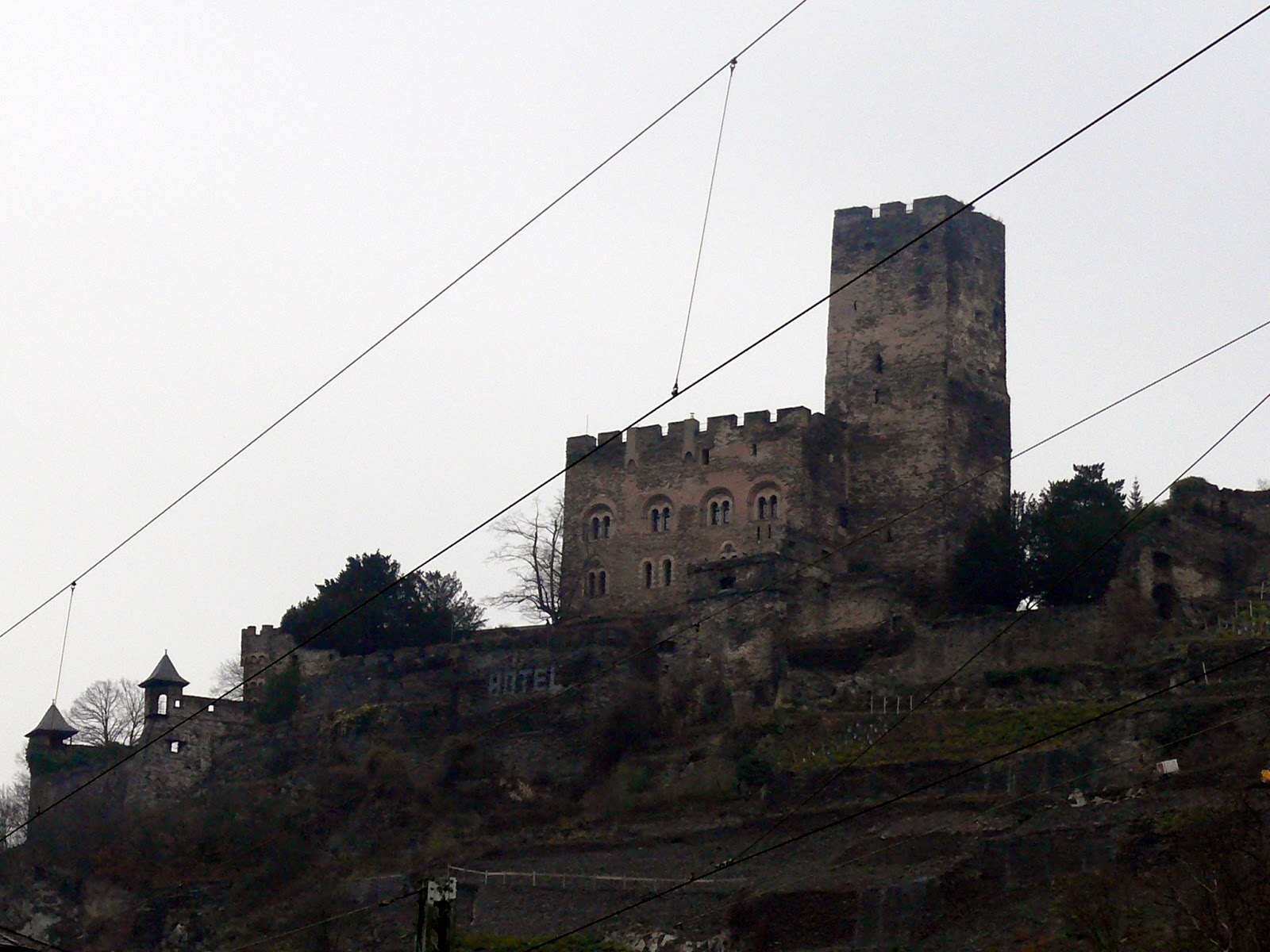 Gutenfels
http://en.wikipedia.org/wiki/Burg_Gutenfels
"The Burg Gutenfels (also known as castle Caub) is a castle 110m above the town of Kaub in Rhineland-Palatinate, Germany. It was build in 1220. It was used with Pfalzgrafenstein Castle in the middle of the Rhein and the fortified city of Kaub on the far side to provide an impenetrable toll zone for the Holy Roman Emperor until Prussia purchased the area (1866) and ended this toll in 1867. The Castle is in part of the Rhine Gorge, a UNESCO World Heritage Site added in 2002."

Katz
source:http://en.wikipedia.org/wiki/Katz_Castle"Katz Castle (German: Burg Katz) is a castle above the German town of St. Goarshausen in Rhineland-Palatinate. This magnificent castle stands on a ledge looking downstream from the riverside at St. Goar. It was first built around 1371 by Count Wilhelm II of Katzenelnbogen. The castle was bombarded in 1806 by Napoleon and rebuilt in the late 19th century, between 1896-98. It is now privately owned, and not open for visitors."
We actually drove to St. Goar, to the top of the hills, and got a magnificent view of the castle from above.


 Rheinfels
source:
http://en.wikipedia.org/wiki/Rheinfels_Castle
"Rheinfels Castle (German: Burg Rheinfels) is a castle ruin located above the left (East) bank of the Rhein in Sankt Goar, Germany. It was started in 1245 by Count Diether V of Katzenelnbogen. After expansions, it was the largest fortress in the Middle Rhein Valley between Koblenz and Mainz. It was slighted by French Revolutionary Army troops in 1797. It is the largest castle overlooking the Rhine, and historically covered five times its current area.
While much of the castle is a ruin, some of the outer buildings are now a luxury hotel, "wellness" centre and restaurant. There is also a museum within some of the better preserved structures."
 Marksburg
http://www.marksburg.de/english/frame.htm
"Marksburg Castle is the only hill castle on the Rhine that has never been destroyed. It has been lived in for over 700 years and thus represents an ever-changing and developing building complex that has been growing into its present shape over the centuries.
On the Rhine's right bank, upstream from its junction with the Mosel, a hill rises above the town of Braubach. Crowning the hill is Marksburg Castle, its unusually slender keep towering above the surrounding courts and ramparts.
Beginning with the construction of the keep in the 12th century, the castle grew into its present shape throughout succeeding centuries. In the Middle Ages, the strengthening of the castle's defences became essential and urgent by improvements made to firearms. Huge outworks date from this time, as does the conversion of a gateway in the outer wall to a strong bastion. It is mainly due to these extra defence works that the castle was never seriously attacked. In more peaceful times, it was used mainly as a state prison."
 |
Koblenz
We completed our trip with a short and blustery visit to Koblenz. We went to see the Deutsches Eck (German Corner), the Basilica of St. Castor, and the Christmas Markets, before taking the less scenic route back home to Wiesbaden.


 Posts
Posts


